If your face is round, the cuts that consistently look good all do the same two things: they add vertical line and they take bulk away from the widest part of your face, which is your cheeks. That is the whole rule. Long layers starting below the chin, a lob cut at or below the jaw, curtain bangs, a deep side part, a long shag, a pixie with height on top, and a high ponytail are simply seven different ways of applying it.
Below is what each one actually does to the shape of your face, what tends to work against you and why, where to place color, and how to get the volume in the right place when you style it. At the end, a way to test all of it on your own photo instead of squinting at a chart.
How to tell if your face is actually round
Pull your hair back, face a mirror straight on, and take four measurements with a soft tape or a piece of string: forehead at its widest, cheekbones at their widest, jaw from one corner to the other, and face length from hairline to the bottom of your chin.
A round face reads like this:
- Length and width are close. The face length and the cheekbone width land within roughly ten percent of each other. It is not a circle, but it is much closer to square proportions than to a long oval.
- The cheekbones are the widest point. Wider than the forehead, wider than the jaw.
- The jaw curves. Run a finger from your earlobe to your chin. On a round face that path is one continuous curve with no corner in it.
- The hairline is rounded too, rather than squared off at the temples or peaked into a widow's peak.
The shape people most often confuse with round is square, because both are close to as wide as they are long. The jaw is what separates them: a square jaw has a visible corner under the ear and a flat line along the bottom. If you have that corner, the recommendations below still help, but you are working with angles rather than curves, and the softening advice differs. Our guide to finding your face shape walks through all six shapes with the measurements.
One thing worth saying plainly: face fullness and face shape are not the same thing. Weight, age, sleep and water all move fullness around. Bone structure is what a haircut is actually working with, so measure to the bone at the cheek and jaw, not to the softest point.
The principle behind every cut on this list
The eye reads the longest unbroken line in a shape first, and it reads contrast before it reads detail. A haircut is a frame, and a frame either carries your eye up and down or it carries it across.
So there are only two questions to ask about any cut you are considering:
- Where is the widest point of the hair? If the hair is widest level with your cheekbones, it stacks width onto the widest part of your face and the whole thing reads rounder.
- Does the shape end on a vertical, a diagonal, or a horizontal? Horizontal lines across the face at cheek or chin level cut the face into short sections. Verticals and diagonals stretch it.
That is it. Every recommendation below is one of those two levers being pulled. If you would rather see the principle tested than described, the face shape page shows the same logic running against a real photo, which is a faster way to settle it than reading.
The cuts that work on a round face
Long layers that start below the chin
The mistake in a layered cut is not layers, it is where the shortest layer sits. A layer cut in at cheekbone level puts the springiest, most voluminous piece of hair exactly where you have the most width already, and it flicks outward as it dries.
Start the first layer below the chin and the top half of the haircut stays narrow and close to the head, hugging the sides of your face. The width then happens lower down, past the jaw, where extra volume lengthens the outline instead of widening it. Ask for the shortest layer to fall at collarbone level or below if your hair is long.
The long bob, cut at or below the jaw
The ends of a bob draw the strongest horizontal line in the whole haircut, so the only decision that really matters is where that line lands. At mid cheek or right at the chin, it lands across the widest section of your face and points at it. Drop the same cut to jaw level or an inch or two under, and the line finishes past the curve, so what you see at the sides of your face is length, not width.
Two refinements make it better. Cut the front pieces slightly longer than the back, so the outline runs on a diagonal toward your chin instead of straight across. And keep the ends soft rather than blunt, because a heavy blunt edge sitting on the shoulders will flare outward.
Curtain bangs
Your forehead is vertical length you already own. A full fringe covers it, so the face you can see becomes shorter, and a shorter face at the same width reads rounder.
Curtain bangs split at the center and sweep out and down toward the cheekbone. That leaves a triangle of forehead visible in the middle, so you keep the length, and it draws two diagonal lines across the top of your face. Diagonals do more work here than a flat fringe line, because a diagonal adds length and breaks the left to right symmetry at the same time, and symmetry is half of what makes a round face read as round. Cut short at the middle and long enough at the outside to graze the cheekbone. Read the fuller version on the bangs page, including the styles that go the other way.
A deep side part
Moving your part two inches sideways costs nothing and changes more than most haircuts do. A center part draws a straight line down the middle and then mirrors the face, repeating the symmetry that already makes a round face read as round. A deep side part sets the bulk of your hair off center, throws a diagonal sweep across your forehead, and gives you more volume on one side than the other, which the eye follows.
Deep means over the arch of the eyebrow, not just slightly off center. Half hearted side parts fall back to the middle within an hour.
The long shag
A shag is layers plus texture, and the two do different jobs here. The interior layering removes weight from the sides, so the hair falls closer to the head at cheek level. The shorter pieces around the crown stack up and build height on top. Narrow at the cheeks and tall at the crown is the exact ratio a round face benefits from, and a shag delivers both from a single cut.
If the full seventies version is too much, ask for a soft or modern shag: same internal layering, less of a visible step at the front, and length kept past the collarbone.
A pixie with height on top and short sides
Short hair is not off limits on a round face. Proportion is what decides it. A pixie cut to roughly the same length everywhere becomes a round soft cap sitting on a round soft face, and the two shapes agree with each other in a way that flattens both.
Cut the same length short at the sides and back and leave two or three inches on top that you can lift, and you have added visible height above the head while narrowing everything at cheek level. Keep a longer piece at the front so it falls on a diagonal across the forehead rather than a straight fringe.
High ponytails and half up styles
When you tie your hair up, the tie point becomes the highest point of your silhouette. Sit it high on the crown and you have extended the vertical line of your head past your hairline, for free, in ten seconds.
Leave two face framing pieces down at the front so they break the outline of your cheek on the way past. The version that works against you is the opposite: a low ponytail with the sides pulled flat and smooth, which exposes the full circle of your face with nothing softening the edges.
Seven cuts, one photo, no growing anything back out
Reading the geometry gets you part way. Upload one selfie in HairGlam and see the jaw length lob, the long shag, the curtain bangs and the pixie land on your own cheekbones, then decide.

What tends to fight a round face
These are tendencies, not rules, and plenty of people wear every one of them well. Usually that is because something else is balancing it: a lot of natural texture, a high forehead, strong brows, a longer neck. But if a haircut has ever felt wrong on you and you could not say why, the reason is often on this list.
- A blunt bob that stops at the chin. It puts a hard horizontal edge at the exact level where your face is widest, and blunt ends flare outward as they dry, adding width on top of the line. The same bob two inches longer is a different haircut on you.
- Heavy bangs cut straight across. They remove the forehead from view, which shortens the length your face reads at, and they add a second horizontal line high up. Paired with a chin length bob you get two horizontal lines close together with the widest part of your face framed between them.
- One length hair with no layers at all. Without interior shaping the hair falls as a solid curtain that is widest where your head is widest, just above the ears, then hangs straight down. There is no shape to carry the eye anywhere, so the face keeps its own proportions with nothing added.
- A center part with flat roots. The part mirrors an already symmetrical face and the flat root removes the only height you had. Notice that the fix is usually the roots, not the part. Lifted roots plus a center part plus length past the collarbone reads perfectly vertical.
Two of these turn around with texture. A chin length bob on hair with real wave in it does not draw a clean horizontal line, it draws a broken one, and broken lines behave differently. That is exactly the kind of thing worth checking against your own hair rather than a rule.
Where to put color on a round face
Color is a contrast tool before it is a fashion choice. Light advances toward the viewer and dark recedes, which means placement changes perceived shape even when the shade stays the same.
Face framing highlights. Brighter pieces at the front, starting around eye level and running down through the ends, create two vertical strips of light at the edges of your face. The eye tracks a bright line from top to bottom, which is a vertical read. This is what the money piece is doing when it works, and why a face framing highlight can flatter more than a full head of the same color.
Darker underneath and around the sides. Keeping the base deeper at the roots, under the ears, and through the underneath layers makes the outer edge of the hair recede visually, so the perimeter reads narrower against your cheeks. A root shadow does the same job at the top: it stops the crown glowing outward and keeps the depth where the shape should sit close.
Vertical placement rather than horizontal. A balayage painted in long vertical sweeps supports the same read. Chunky horizontal bands of contrast do the opposite, cutting the hair into sections across.
A full head of one bright shade is the flattest option. If everything advances equally, the shape reads at its true width. That is not a reason to avoid all over blonde, it is a reason to keep depth at the root and at the sides if you go there.
Warm versus cool is a separate question, decided by your skin tone rather than your face shape. What is worth remembering is that a cut grows out and a bleach job does not. Seeing platinum, burgundy or a money piece against your own skin before you book is the cheapest test available, and the hair color try on exists for exactly that.
Styling: put the volume on top, not on the sides
A good cut can be undone in ten minutes with a hairdryer. The goal every time you style is the same: height above the crown, smoothness at the temples and cheeks.
- Dry the roots first, overdirected. Take the top section, lift it straight up or slightly back from where it grows, and dry the first inch at the root before anything else. Hair sets in the direction it dries in.
- Use the round brush only on the crown. Lift and turn the top sections, then let the mids and ends dry straight and fall close. A round brush used all the way down the sides creates the outward flick you are trying to avoid.
- Velcro rollers in the top section while you do the rest. Two or three at the crown, left in for the length of your makeup routine, will hold more lift than any product.
- Dry the front away from your face. Push the fringe or front pieces back and across on your part side, so they set with a diagonal sweep rather than falling forward onto your cheek.
- Two products, two places. Texture spray or a light powder at the roots on top, a smoothing cream through the lengths at the sides. Putting volumizer everywhere is how you end up wide.
- If your hair is curly, clip the roots at the crown while it dries rather than diffusing evenly. Curls naturally build width at the sides, so the height at the top has to be created deliberately, and length past the jaw does more for you than a shorter curly cut.
See the cut on your own face before you book
Everything above is a tendency drawn from geometry, and geometry does not know about your hairline, your density, your neck, or the way your hair actually behaves at 4pm. The only way past that is to look at the cut on your face. Not on a model with a long oval face who was cast because the cut already suited her.
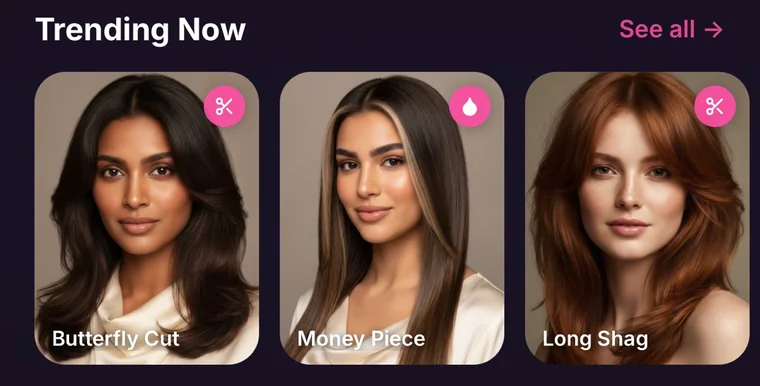
That is what HairGlam does. You upload one front facing photo, and the app renders the hairstyle onto your photo, keeping your features, your skin tone and your lighting. On the Home tab there is an Upload Photo button under "Discover your perfect hairstyle", then rows for Today's Picks, Trending Now, Hair Colors and Celebrity Looks. The Discover tab has a search field and filter chips for All, Trending, Bold Color, Bob and Curly, with each card labeled as a cut and a color together, like "Long Straight · Espresso" or "Beach Waves · Caramel Highlights". There are over 240 styles and colors in total.
A test worth running, in this order:
- The same bob at two lengths. Chin length against jaw length. This one comparison teaches you more about your own face than any chart, because you can see the horizontal line move.
- Curtain bangs against a blunt fringe. If your forehead is on the higher side, the blunt fringe may well win, and you would never have tried it.
- The long shag and the pixie. The two ends of the range. If the pixie with height works, you have a much bigger set of options than you thought.
- One color change on the winning cut. Add a money piece and look at the difference in width, not the difference in color.
Save the ones that work and take them to your stylist. A render of the cut on your own head is a far clearer brief than a photo of someone else, and salon miscommunication almost always starts with that photo of someone else.
The app is free to download and works on any iPhone running iOS 15.1 or later. HairGlam Pro is an auto renewing subscription, weekly or yearly, which you can cancel in your App Store account settings. It is a new app: the App Store rating is 5.0 from 2 ratings, which is two people, so treat it as a fact rather than a recommendation and judge the result on your own photo.
Common questions
How do I know if my face is round and not square?
Can I have a round face and still get a bob?
Do bangs suit a round face?
Should I avoid a center part completely?
Does hair color really change how wide my face looks?
What is the fastest way to see a cut on my own face before I book?
Keep reading
If you are not certain your face is round, start with how to know your face shape, which covers the measurements for all six. If you have settled it and want the cut recommendations for every shape in one place, what haircut suits me is the page for that. The bangs guide handles the fringe question on its own, and the rest of the guides live on the blog.