Every face shape chart uses the oval as its reference, and every one of them tells you the same thing: an oval suits almost any haircut. That is broadly true, and as advice it is nearly worthless. It tells you what you are permitted to do and nothing at all about what to pick.
The useful version of this guide starts from a different place. On a round or a square face a haircut has a job to do: add length, soften a corner, take bulk off the cheek. On an oval face there is no such job, so the cut stops being a correction and becomes a choice. What decides it is no longer your face shape. It is the proportions inside your oval, what your hair texture will actually hold, and which feature you want the eye to land on. Below is what each length does to those proportions, the two things genuinely worth avoiding, and a way to settle it on your own photo.
First, check that your face is actually oval
Pull your hair back, stand square to a mirror in even light, and take four measurements with a soft tape or a length of string: forehead at its widest, cheekbones at their widest, jaw straight across from corner to corner, and length from hairline to the bottom of your chin.
An oval reads like this:
- Length is around one and a half times the cheekbone width. Clearly longer than it is wide, but not dramatically so.
- The three widths taper. Cheekbones widest, forehead a little narrower, jaw narrower again. The step down is gentle rather than sharp.
- The jaw curves and the chin is rounded, with no corner under the ear and no point at the bottom.
The shape an oval gets confused with is long, also called oblong, and almost never round. Both an oval and a long face are longer than they are wide, so length will not separate them. The taper is what does. On a long face the forehead, cheekbones and jaw all come out close to the same width, so the sides of the face run roughly parallel from temple to jaw. On an oval they narrow as they descend. If your three widths are within a centimeter or so of each other, read the long face advice instead, because the two shapes want opposite things from a fringe.
The other near miss is heart. A heart shape also tapers, but far more sharply, and it is the forehead rather than the cheekbones that measures widest, finishing in a pointed chin. If the taper feels dramatic rather than gentle, that is the shape to read about. The full method for all six, including the mistakes that give you the wrong answer, is in how to know your face shape.
Why "oval suits everything" is true, and why it is useless
It is worth understanding why the rule exists, because that is what tells you when it stops applying.
A haircut recommendation is almost always a balancing instruction. A round face is told to add vertical because its width and length are close. A square jaw is told to add curves because it has corners. A heart shape is told to build weight low because its width sits high. In each case there is a dominant feature and the cut is being asked to offset it.
An oval has no dominant feature. The widths taper gently, the length sits comfortably above the width, and nothing needs offsetting. So no cut is disqualified, and the entire category of corrective advice simply has nothing to grip on.
That produces one genuinely useful consequence, and it is the single most practical thing on this page. Horizontal lines are available to you. A blunt edge cutting straight across at chin level is the one thing a round face has to be careful about, because it lands on the widest point and draws attention to it. An oval has no excess width there for that line to amplify, so the same cut just reads as a sharp bob. Where the round face guide spends its time steering you away from horizontals, you can use them freely, and that opens up most of the cuts other people are told to approach carefully.
The flip side is that your failure mode moves. You are not going to make an oval face look wider. You can make it look longer, and you can flatten the balance that was the asset in the first place. Both of those are covered further down.
What each length does to an oval face
Since nothing needs correcting, the honest way to organize this is by what you are actually choosing between, which is length.
Very long, past the mid back
Long hair hangs in a straight line beside a face that is already longer than it is wide, and it adds that line to your outline. Worn one length, parted down the middle, flat at the root and straight to the ends, it is the one thing an oval can genuinely overdo, because it is vertical stacked on vertical.
The fix is not to cut it. It is to break the line. Long layers, a wave, a side part, or an inch of lift at the root will each interrupt the vertical and the issue disappears. Note that this is a styling problem more than a cutting problem, which is why the same length looks different on the same person on different days.
Collarbone length
The most forgiving length on an oval and a reasonable default if you are undecided. The ends finish below the jaw, so the widest part of the hair sits off the face entirely, and there is still enough length to hold a bend or a layer. It is long enough to tie back and short enough to keep weight off the ends.
If you want the cut to do something rather than just sit there, ask for the front pieces to be cut a touch shorter so they fall at the cheekbone. On an oval that is not a corrective move, it is an emphasis move, and the cheekbone is generally the feature worth emphasising because it is the widest point of the taper.
The lob at the jaw
The length that flatters most people regardless of shape, and on an oval it is simply a good cut rather than a rescue. Because the ends land at the jaw, the outline of the haircut finishes exactly where the taper of your face finishes, so the two shapes agree with each other.
You have a free choice on the ends here that a round face does not. Blunt reads sharp and deliberate. Soft or slightly point cut reads relaxed. Neither one is fighting your face, so pick on the basis of how much time you want to spend on it, since a blunt edge shows every bend and needs more attention.
A blunt bob at the chin
This is the cut the charts warn round faces away from, and the one an oval can take without qualification. It introduces the strongest horizontal line available in a haircut, at the level where your face has already begun to narrow.
If your measurements put you at the longer end of oval, close to the boundary with oblong, this is actively worth considering rather than merely allowed. The horizontal shortens the read of the face, which is the one adjustment a long oval might want. It is the clearest example of the principle that your proportions inside the oval matter more than the label.
A pixie or a short crop
Oval is the shape that takes very short hair most easily, and the reason is worth stating properly rather than asserting. A crop removes the frame from around the face almost entirely. Whatever proportions you have are then on full display with nothing to soften or redirect them. That is a problem when something needs balancing and a non issue when nothing does, which is the definition of an oval.
So the constraint on a pixie is not your face shape, it is everything else: your hair texture, your hairline, your ears, your neck length, and how often you are willing to see a barber. Short hair is high maintenance in weeks, not minutes.
Bangs, which are a separate lever entirely
Bangs are worth pulling out of the length discussion because they are decided by a different measurement. A fringe takes vertical forehead out of view and replaces it with a horizontal line. Whether that helps depends on how much forehead you have, not on whether your face is oval.
A high forehead inside an oval is the case where a full fringe genuinely earns its place, because there is length there to give away. A short forehead is the opposite: a heavy fringe leaves very little face above the brows and the proportions end up top heavy. Curtain bangs sit between the two, taking some length out of the forehead while leaving a triangle of it visible, which is why they are the low risk option when you are not sure. The bangs page goes through the styles individually.
Five lengths, one photo, nothing grown back out
The chin length bob against the collarbone cut is the comparison that settles this, and it takes about a minute. Upload one selfie in HairGlam and watch both land on your own jaw.

The two things worth avoiding
There is no long list of banned cuts for an oval face, which is the whole point. There are two patterns that reliably work against one, and both are about the hair as a whole rather than any single cut.
1. Stacking vertical on vertical
Very long one length hair, flat roots, a straight centre part and height piled at the crown are each adding length to a face that is already the longer than wide shape. Any one of them alone is fine. Put three of them together and you are pushing an oval toward oblong, which is the only direction it can realistically be pushed.
The tell is that it looks worse in photographs than in the mirror, because a camera flattens the depth that was making it read as volume rather than length. If you want the crown height, take the length down or add a wave. If you want the length, keep the crown closer to the head.
2. Burying the balance
A heavy blunt fringe combined with heavy one length hair either side closes the face into a narrow window between two horizontal lines. Your forehead disappears above and your jaw disappears behind. What is left visible is a strip through the middle.
The reason this is a loss specifically for an oval is that the gentle taper from cheekbone to jaw is the thing that was working for you. It is what makes the shape read as balanced. Hiding both ends of that taper hides the asset and leaves a fairly flat rectangle of face on display. Keep one of the two open: either the forehead or the jawline, and preferably the jawline.
Where your own proportions change the answer
Two people can both measure oval and want different haircuts, because the label describes the outline and not what sits inside it. Three measurements do more work than the shape name once you have it.
- Forehead height. The single most useful number after the four you already took. Measure from the top of your brows to your hairline. If it is more than about a third of your total face length, you have forehead to spend and a fringe is on the table. If it is well under a third, keep it open and let the hair start further back.
- Chin and lower face length. A longer distance from the bottom of the nose to the chin is what tips an oval toward reading as long. That is the case where ends finishing at or above the jaw help, and where very long flat hair does not.
- Neck length. Nothing to do with your face and it decides half of the short hair question. A longer neck carries a pixie or a very short crop comfortably. A shorter neck does better with either real length or a cut that leaves some weight at the nape, because a crop plus a short neck compresses the whole outline.
Texture and density do more than the shape does
Once face shape stops constraining the answer, hair behavior becomes the main constraint, and it is the thing most likely to make a cut look different on you than in the reference photo.
- Fine hair. Heavy layering removes what little weight is at the ends and the hair finishes in a wispy point. A blunter line at collarbone or above keeps the perimeter looking dense, and an oval can take that blunt line without any of the usual caveats.
- Thick or coarse hair. The opposite problem. Left one length it builds a solid triangle, wide at the bottom. Internal layering removes weight without changing the outline, which is a different request from layers you can see.
- Curly hair. Curl shrinks, often by a lot, so the length you ask for wet is not the length you get dry. Discuss the cut in terms of where you want it to sit when dry. Curls also build width at the sides, which on an oval is a fair trade rather than a problem, since you have length to balance it against.
- Straight and flat. The texture most likely to trigger the vertical stacking problem above. It is also the texture that shows a blunt cut best, so a defined line does more for you than layers.
Color, briefly
Color placement on a round or square face is doing structural work, narrowing the sides or softening a corner. On an oval it is not correcting anything, so this section is short on purpose. Placement is free, and the decision is about interest and dimension rather than shape.
The one thing worth keeping is depth somewhere. A single flat shade over the whole head removes the variation that makes hair look like it has volume, which on an oval matters because you may already be dealing with a long flat vertical. A root shadow, a few darker pieces underneath, or a soft balayage all put dimension back without committing you to a full change. Seeing it against your own skin before you book is the cheap version of that decision, which is what the hair color try on is for.
See it on your own face before you book
Everything above is geometry, and geometry does not know your hairline, your density, or how your hair behaves by the end of the day. On an oval face that gap matters more than it does elsewhere, because the chart has already told you everything is allowed. The only thing that narrows it down is looking.
HairGlam is built for that step. One front facing photo goes in, and the app regenerates it wearing the style you chose, holding on to your features, your skin tone and the lighting you shot in, instead of handing you the cut on a model who was cast because it already suited her. Practically: the home screen opens on an Upload Photo button, with rows beneath it for Today's Picks, Trending Now, Hair Colors and Celebrity Looks, and the Discover tab adds a search field plus filter chips for All, Trending, Bold Color, Bob and Curly. Every card names a cut and a color together. The catalog runs to more than 240 styles and colors.
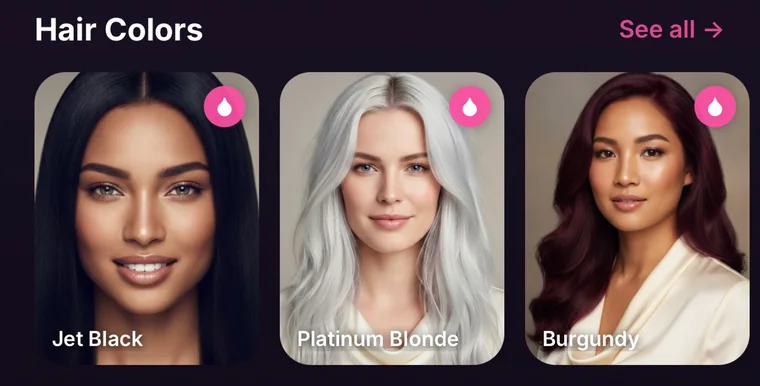
Because nothing is ruled out for you, comparing is more useful than browsing. A test worth running, in this order:
- The chin length blunt bob against the collarbone cut. This is the comparison that matters most on an oval, since both are genuinely open to you. Look at where the ends land relative to your jaw, not at which photo you like better.
- A fringe against no fringe. This one is decided by your forehead, and it is the fastest way to read your own forehead height without measuring it.
- The pixie. Oval is the shape most likely to carry it, and most people never try it because cutting is irreversible. Here it costs nothing.
- Long and flat against long with movement. The same length, once straight and once with a wave. This is the vertical stacking problem from earlier, visible in two images.
Keep the two or three that survive that and bring them to the appointment. Handing over an image of the cut sitting on your own head removes the translation step, which is where most of these conversations go wrong: your stylist is otherwise reverse engineering what you liked about a picture of a stranger.
The app is free to download and runs on iPhone and iPad with iOS 15.1 or later. HairGlam Pro is an auto renewing subscription, weekly or yearly, cancellable in your App Store account settings. It is a new app: the App Store rating is 5.0 from 2 ratings, which is two people, so treat that as a fact rather than a recommendation and judge the result on your own photo.
Common questions
Is it true that an oval face suits every haircut?
How do I know if my face is oval and not long?
Can an oval face wear a blunt bob at the chin?
Do bangs suit an oval face?
Should I avoid very long hair if my face is oval?
What is the fastest way to check a cut before I commit?
Keep reading
If you are not certain the oval label is right, how to know your face shape has the measurements and the mistakes that skew them. If you measured closer to round, the round face guide is the corrective version of this page. All six shapes are summarized on what haircut suits me, the fringe question has its own bangs guide, and if you are deciding which app to use for the try on, the hands on comparison of eight of them names real competitors. The rest is on the blog.